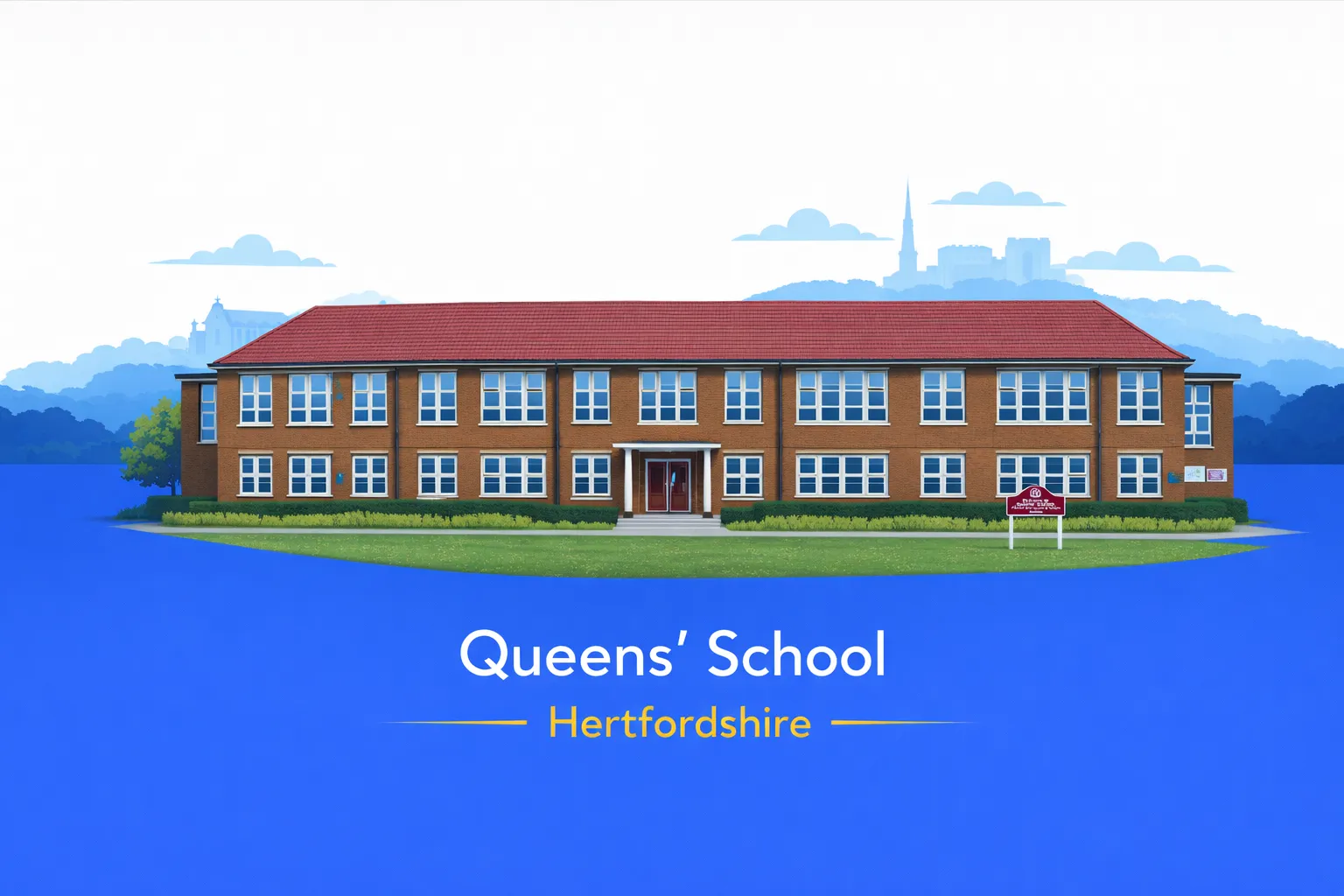
Queens' School 11+ Guide 2026
Choosing a grammar school is an important step in your child's education. This independent guide by Rurera explains how entry to Queens' School works, what the 11+ assessment involves. In addition, it provides students with structured practice, expert guidance, and progress tracking to improve exam readiness.
60-SECOND SUMMERY
- Type: Queens' School is a selective Mixed Boys and Girls in Hertfordshire with 270 places per year.
- Exam: Admission is based on the 11+ covering Maths, No, and No.
- Registration: Opens Monday, 31 March 2025 and closes Thursday, 5 June 2025.
- Catchment: Yes areas may get priority for admission (check the admissions policy).
- Offers: Depend on scores and oversubscription rules.
- Test date: Friday, 5 September 2025; results: Monday, 7 September 2026.
- CAF deadline: Submit school preferences by Thursday, 30 October 2025 through the CAF system.
- Preparation: Rurera provides mock tests, practice papers, and progress tracking.
- Ofsted: Rated Outstanding on Tuesday, 18 March 2025.
- Tip: Start early to build confidence and reduce exam stress.
Queens' School Overview
Queens' School Hertfordshire is a partially selective, co-educational academy in Bushey, Hertfordshire, rated Outstanding by Ofsted, with a strong reputation for academic and extracurricular excellence.
The school offers a challenging curriculum alongside rich opportunities in music, sport and community involvement, supported by excellent pastoral care.
Each year, 270 pupils are admitted to Year 7 through a combination of academic, music and distance-based places, making entry highly competitive.
- Local authority
- Hertfordshire
- Catchment area
- Yes
- Fees
- State-funded
- School type
- Day School
- Types
- Mixed Boys and Girls
- Places per year
- 270
- Ofsted rating
- Outstanding
- Admission type
- Selective
- Exam format
- GL Assessment
Grammar Schools in Same Consortium
Queens' School Contact Information
School address
Queens' School
Queens' School, Aldenham Rd, Bushey WD23 2TY, United Kingdom


Key Dates for Your Calendar
Keeping track of admission dates and deadlines can be challenging. The timeline below highlights the key milestones to help you plan ahead and ensure nothing is missed.
- Registration window opens:
- Registration window closes:
- 11+ assessment takes place:
- Results shared with parents:
- Kent Test (Out-of-County Schools):
- Application deadline (CAF):
- National offer day:
Queens' School Admissions Process
Applying to Queens' School for Year 7 is a clear, step-by-step process. Following each stage carefully ensures your child's application is complete and considered on time. Being familiar with the process helps parents plan ahead and avoid missing key deadlines.
Admissions Policy 2026
It is important to read the Queens' School Admissions Policy PDF carefully. The document explains the eligibility criteria and provides full details of the admission process.
Read PolicyRegister for the entrance assessment
Parents must complete registration for the entrance assessment within the published registration window. This registration is handled separately from the local council application. Making sure all information is correct will secure your child's place for the assessment.
Register NowSubmit your secondary school preferences
If your child meets the required standard, you must list Queens' School on your Common Application Form (CAF) before Thursday, 30 October 2025.
What to Expect in the Queens' School 11+ exam?
The Queens' School 11 Plus exam is administered by FSCE and takes place in early autumn of Year 6. All test papers are completed in one day at the school. The exam includes a mix of multiple-choice and written response questions, designed to assess reasoning and core academic skills.
Children are tested on Key Stage 2-level content, focusing on knowledge taught up to the end of Year 5, so no unfamiliar curriculum content is included.
Exam papers typically include:
English
The English paper consists of reading comprehension and creative writing tasks. It tests students' ability to understand written texts and answer questions accurately. Pupils are also assessed on grammar, spelling, punctuation, and vocabulary. The creative writing section evaluates imagination, structure, and clarity of expression. Strong reading and writing skills are essential for success in this paper.
Maths
The Mathematics paper is based on the Key Stage 2 curriculum, covering topics from Year 5 and Year 6. It includes questions on arithmetic, fractions, decimals, percentages, and problem-solving. Students are expected to show clear working and logical thinking. Accuracy and time management are important throughout the test. This paper measures both mathematical understanding and reasoning ability.
Verbal Reasoning
The Verbal Reasoning paper usually lasts around 30 minutes and begins with a short practice session. It tests students' understanding of words and language patterns. Questions involve synonyms, codes, sequences, and relationships. Logical thinking and reading skills are essential. A strong vocabulary greatly supports performance.
Non Verbal Reasoning
The Non-Verbal Reasoning section is divided into shorter, timed parts. It focuses on visual problem-solving and spatial awareness. Students analyse shapes, diagrams, and sequences. Questions require logical thinking without the use of words. Careful observation and pattern recognition are key skills.
AD1
The creative writing task usually lasts around 40 minutes and includes time for planning. Students are asked to produce an imaginative and structured piece of writing. They organise ideas clearly with an introduction, middle, and ending. Spelling, grammar, and vocabulary are carefully assessed. Creativity, originality, and clarity are also important.
AD2
The first stage takes place after school on Monday 8th September 2025 and lasts around 45 minutes. It is a written test with 60 recorded questions played on a CD, assessing musical aptitude rather than prior musical knowledge. Children are tested on pitch (recognising higher, lower or identical sounds), melody (identifying changes in short tunes), rhythm (spotting differences in four-beat patterns) and texture (deciding how many notes are in a chord). No music theory is required.
AD3
Pupils who pass the first round are invited to a second stage between Monday 22nd and Friday 26th September 2025. In this round, children perform or sing a piece of their choice for a panel of examiners, including current and former Directors of Music from South West Herts Consortium schools. Performances are marked on accuracy, musicality, and musical communication, with up to 15 marks in each area. The standard of the piece does not affect scoring, and marks are not age-standardised.
In addition to subject knowledge, the assessment considers verbal and non-verbal reasoning skills. There is no fixed pass mark; instead, pupils must meet the required standard, with final offers determined by scores, available places, and oversubscription criteria.
Take control of your child's 11+ preparation.
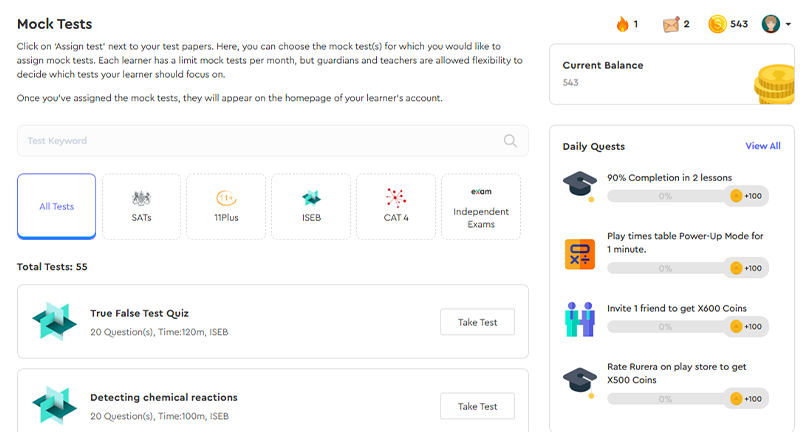

Not sure if your child is on track for the grammar school 11+? You don't need to guess what to cover or whether they're ready. Rurera shows you exactly what to practise each week and how they're performing, so you can stay ahead of the process without the stress.
- Follow personalised weekly exam plans that show them what to learn next.
- Download replica 11+ practice papers and upload a photo for instant, stress-free marking.
- Track progress and see how they compare to others applying to the same schools.
Endorsed by grammar schools, trusted by families.
Start your free trial and help your child feel fully prepared for the 11+.
Try Rurera for freeHow does place allocation work at Queens' School?
If there are more applications than places available, Queens' School applies oversubscription criteria. Priority may be given to children who meet one or more of the following criteria:
- Children whose Education, Health and Care (EHC) plans name the school.
- Children who have a sibling living at the same address who currently attends the school.
- Looked After Children and previously Looked After Children.
- Children who are eligible for pupil premium funding (free school meals).
- Children who have been eligible for pupil premium funding (free school meals) at any point in the last six years.
- Children who have a parent who is a member of staff at the school.
- Children with health or special access reasons that require attendance at the school.
- Other children, ranked in order of distance from the school, measured in a straight line.
Queens' School [does not] operate a catchment area. This means that children are not prioritised based on how close they live to the school.
Preparing for the 11+ Entrance Exam with Rurera
The 11 Plus is a competitive entrance exam for grammar schools, testing skills in English, Maths, Verbal Reasoning, and Non-Verbal Reasoning. Rurera is designed to help pupils prepare effectively for these core areas, with structured practice that reflects the demands of real 11 Plus exams.
Why Rurera Is Good for Learning
Rurera is a powerful learning platform designed to support students from early learning through advanced academic preparation. By combining child-friendly design, interactive learning, structured academic resources, and strong progress tracking, Rurera offers a complete learning experience for both children and parents.
Age-Appropriate and Learner-Centred Design
Rurera is built with age-appropriate design principles that match a child's language level and cognitive development. The platform uses simple navigation, clear instructions, and structured layouts to ensure learners can focus on learning without distractions. As students progress to higher levels, Rurera adapts by offering more structured academic content and exam-focused layouts.
Interactive and Gamified Learning Experience
Rurera integrates interactive tools, games, animations, and engaging activities to make learning enjoyable. These features help younger learners stay motivated while reinforcing key concepts. Gamified elements encourage regular practice and help students develop confidence through continuous engagement.
Rurera delivers an interactive and gamified learning experience by integrating engaging tools, games, animations, and activities that make learning enjoyable and motivating for younger learners, while reinforcing key concepts and building confidence through regular practice. Alongside this, Rurera offers a high-quality, exam-focused curriculum with a wide range of structured resources, including practice and past papers with detailed step-by-step solutions, time management guidance, hints, and exam techniques, as well as subject-specific materials for Maths, English, Verbal Reasoning, and Non-Verbal Reasoning, complemented by Spelling, Punctuation and Grammar (SPaG) and vocabulary-building resources to help learners master core concepts and develop strong exam skills.
Early Preparation and Structured Learning Pathways
Rurera supports early academic preparation by offering learning materials from Year 3 onwards, including age-specific practice papers for younger learners. This allows students to build familiarity with exam-style questions gradually, reducing pressure and improving performance over time.
Rurera supports early academic preparation by offering structured learning materials from Year 3 onwards, including age-specific practice papers that help younger learners gradually build familiarity with exam-style questions, reduce pressure, and improve performance over time. Its learning content is organised into clear, well-defined modules such as past paper-based learning, revision-focused courses, beginner, intermediate, and advanced levels, as well as dedicated scholarship and exam preparation pathways, making it easy for parents and educators to identify and select the most appropriate support for each learner.
Parental Involvement and Monitoring Tools
Rurera encourages strong parental involvement by providing tools that allow parents to monitor learning progress, lesson completion, and performance trends. Parents can stay informed about what their child is learning and provide additional support at home, creating a strong partnership between learners, parents, and educators.
Measuring Progress and Learning Outcomes
Rurera includes robust tracking and assessment tools to measure student progress accurately. Features such as diagnostic assessments, mock exams, quiz scores, lesson completion rates, and time spent on tasks allow educators to understand each learner's strengths and areas for improvement. This data-driven approach helps personalise learning and ensures students receive the right level of support.
Expert Guidance and Personalised Support
Rurera offers personalised tuition and online tutoring supported by expert educators. Learners benefit from tailored teaching strategies based on performance data, ensuring continuous improvement and targeted support.
Get your free 11+ learning plan and topic list
Find out exactly what your child needs to study for their target grammar school. Simply enter the school, and Rurera will generate a personalised 11+ learning plan and topic list aligned to that school's exams so you can focus on what really matters.
Try Rurera for freeQueens' School Ofsted Report
Queens' School was last inspected by Ofsted on Tuesday, 18 March 2025. The inspection lasted one day, and the published report rated the school as Outstanding. A summary of the inspection outcomes is shown below, along with a link to the full Ofsted report.
Ofseted Report Summary
Grammar Schools Near Queens' School

Watford Grammar School for Girls
Ladys Cl, Watford WD18 0AE, United Kingdom1 miles away
Watford Grammar School for Boys
Rickmansworth Rd, Watford WD18 7JF, United Kingdom2 miles away
Croxley Danes School
Baldwins Ln, Croxley Green, Rickmansworth WD3 3LR, United Kingdom3 miles away
Parmiter's School
High Elms Ln, Watford WD25 0UU, United Kingdom3 miles away
Rickmansworth School
Scots Hill, Croxley Green, Rickmansworth WD3 3AQ, United Kingdom4 miles away
St Clement Danes School
Chenies Rd, Chorleywood, Rickmansworth WD3 6EW, United Kingdom6 miles away
These distances are calculated in a straight line. The actual route and distance may vary.
Frequently Asked Questions
Need guidance on the 11 Plus?
We're happy to help!
The 11 Plus can feel a bit overwhelming, but our friendly team is here to answer your questions and support you every step of the way.
Message our team
Related posts
Heckmondwike Grammar School 11+ Guide 2026
South Wilts Grammar School 11+ Guide 2026